Wastewater system maintenance and start-up
Maintenance and Start-up of Ship Wastewater Treatment Plant Requires Bacteria
Ships' wastewater treatment plants are shut down for seasonal maintenance. Sometimes they are also started up for the first time. Due to seasonal variations, the number of passengers can be quite low, resulting in weak biomass in the biological treatment plant, which cannot meet the required treatment standards.
The disadvantage of a biological treatment plant is that it cannot be technically "slowed down." The biological treatment process either happens or it doesn't. All wastewater treatment processes depend heavily on the activity of the biomass.
Starting up the system can be done in various ways, some of which may prove difficult due to insufficient waste feeding, such as after a ship's dry dock. Here we introduce the traditional method for maintaining ship wastewater treatment systems, as well as SmartPipe's advanced and eco-friendly solution.
The Importance of Healthy Bacterial Biomass
In ideal conditions, the biomass of wastewater treatment plants should contain dynamic, diverse, and stable microorganisms working together to reduce organic load and meet treatment standards. Bacteria are the most important microorganisms in biomass, as they are responsible for the complete (oxidation) or partial (fermentation) breakdown of organic materials (COD/BOD). The biomass also includes yeasts and fungi.
Seeding Treatment Systems with the Traditional Method
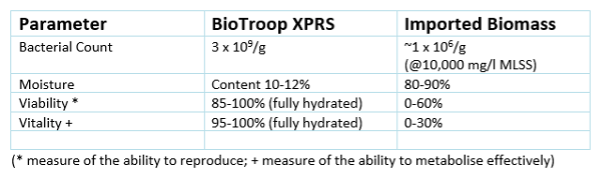
Maintenance and start-up of wastewater treatment systems are traditionally done by introducing active biomass from another system. The method is functional but has several drawbacks concerning the "raw material quality" and start-up schedules. Additionally, it requires significant resources, as the biomass is transported to ships by tanker trucks, increasing start-up costs. Despite the large amount of biomass, the number of beneficial bacteria may be surprisingly low. The biomass is not very uniform and the technology is outdated. This is also why many wastewater treatment plants are willing to share their biomass with others.
Eco-Friendly Solution for System Maintenance and Start-up
SmartPipe's BioTroop XPRS is a biological booster that simplifies the maintenance and start-up of marine wastewater treatment systems. The solution is compact, dry-packed, easy to use, and does not require the introduction of biomass onto the ship via tanker trucks.
Why BioTroop XPRS?
- Contains carefully selected bacteria that work effectively in wastewater systems.Sisältää tarkasti valittuja bakteereja, jotka toimivat tehokkaasti jätevesijärjestelmissä.
- Quickly breaks down organic matter and improves wastewater treatment efficiency.
- Activity can be adjusted if necessary by adding other products from the BioTroop series.
How Does BioTroop XPRS Work?
BioTroop XPRS helps activate biomass and creates a foundation for bacterial growth when drainage is not available. There are several options for creating a growth medium:
- Starts with a fully filled tank and grows biomass over 10-12 days
- Start with a partially filled tank (e.g. 25% of capacity) and gradually increase the flow rate from 50% → 75% → 100% over the first 10 days
SmartPipe recommends the latter method and molasses as a growth medium for bacteria, as its high biological oxygen demand (BOD, typically 900 g/l, 76% sugar) supports rapid bacterial activity.
Please note
If biomass growth is slower than expected, the cause may be toxic substances in the wastewater, such as biodegradable chemicals or cleaning agents. In this case, it is worth reducing the amount of harmful substances and choosing substances that do not impair wastewater treatment.